

The Most Misunderstood CEO in Tech
Commitment signals and the market that rewards them


Most tech CEOs are misunderstood in ordinary ways. People over-attribute success to charisma, or luck, or a single product decision.
Alex Karp is misunderstood in a stranger way: people misclassify what kind of company he runs, so they reach for the wrong interpretive template entirely.
They evaluate him like a consumer-tech founder. He is not one.
They evaluate Palantir like a data company. It is not one.
The result is that Karp gets filed under “eccentric,” “controversial,” or “ideological,” when the more accurate file is “institutional operator selling cognition at scale.”
The Commitment Signal
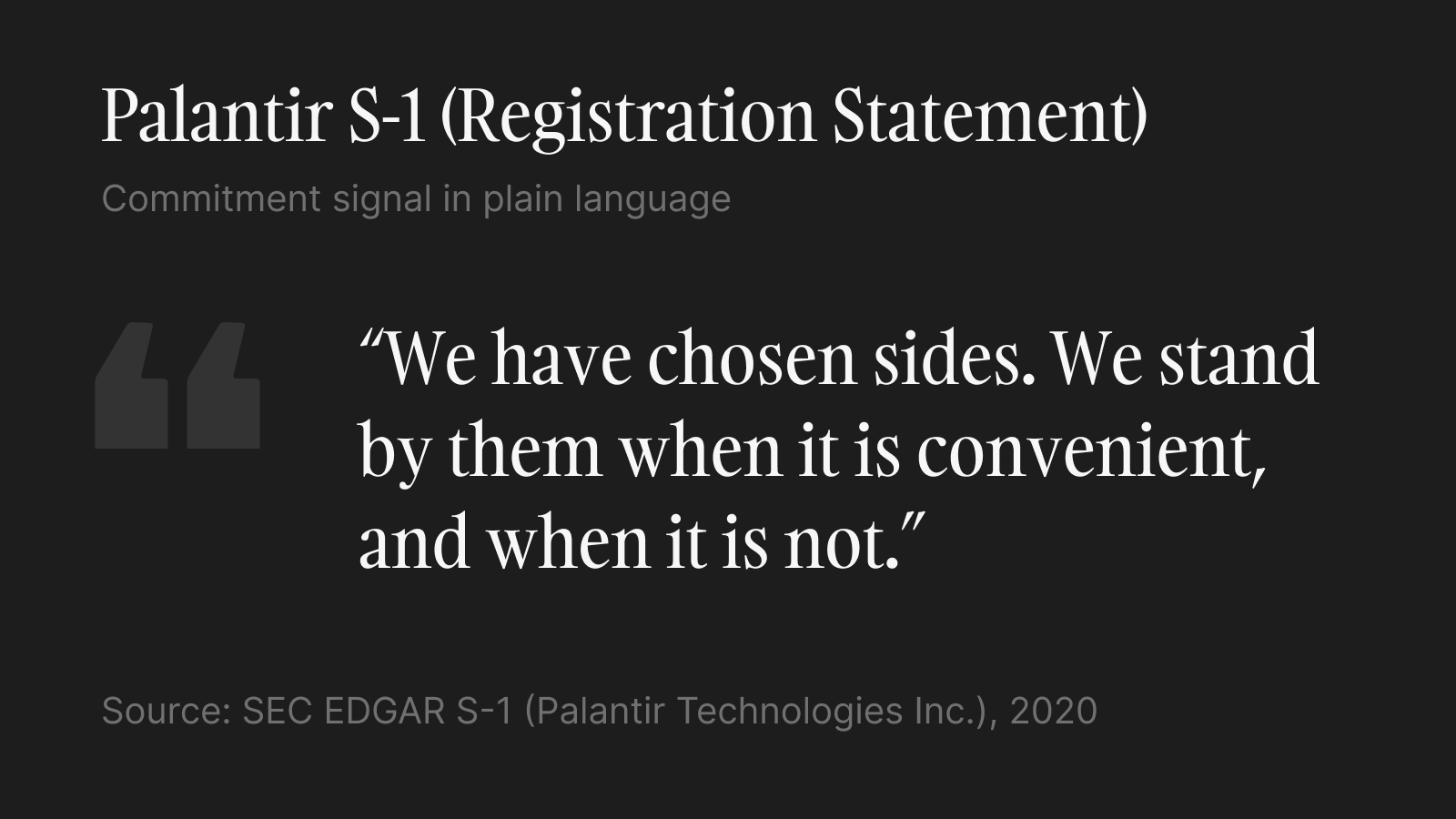
Read Palantir’s S-1 filing and you’ll find language that would make any normal tech PR team faint. “We have chosen sides,” the company declares, framing its software as a duty to “keep soldiers safe” and explicitly tying its product to “our most vital institutions.”
In a market where CEOs are trained to sound values-neutral and customer-agnostic, Karp narrows the moral and geopolitical frame, polarizes the audience, and keeps going.
If you interpret that as a personality quirk, you miss what it’s actually doing:
This is a commitment signal. It constrains optionality on purpose.
It tells institutional customers (often the state or state-adjacent organizations) that Palantir won’t treat them as an embarrassing phase to grow out of. It tells prospective employees this company won’t rebrand the moment the cultural climate shifts.
In markets where credibility means surviving consequences, Karp is making himself legible to the people who buy consequences.
Two Kinds of Software
To see why this works, you need to understand two kinds of software and why Palantir is playing a different game entirely.
Call it Type A versus Type B.
Type A software is built for clean environments. It wins by being simple, self-serve, and scalable. The customer adapts to the product.
Type B software is built for hostile environments. It wins by being adaptable, secure, and embedded. The product adapts to the customer.
“Hostile” here doesn’t mean violent. It means high stakes, high friction, and high constraint: legacy systems, compliance, coalition politics, adversarial threats, operational urgency.
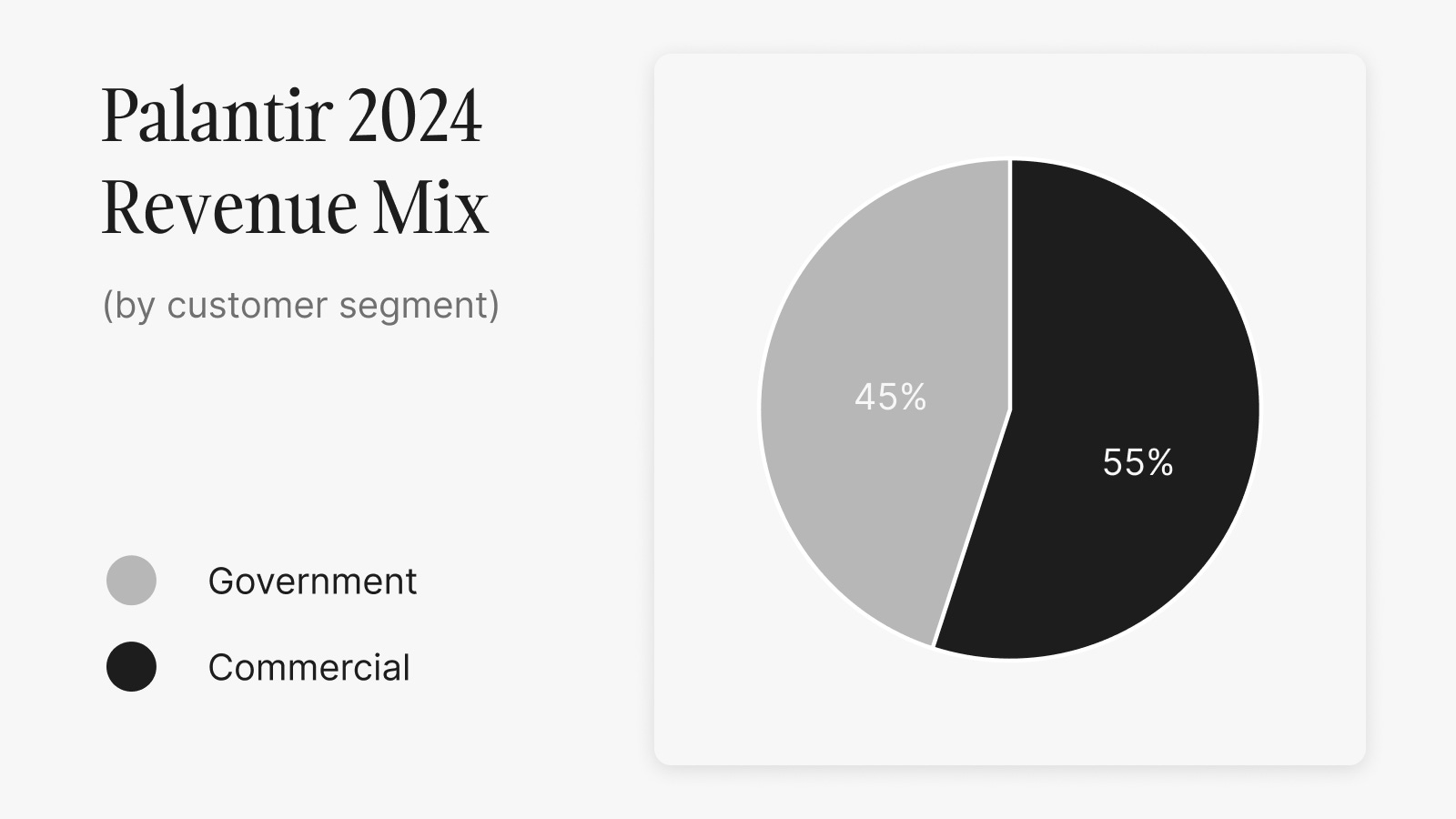
Palantir is Type B. According to their 2024 annual report (the most recent annual report available at the time of this writing in early 2026), 55% of revenue came from government customers and 45% from commercial.
That alone should push you away from the default Silicon Valley mental model. This is not a company monetizing attention or convenience. Its center of gravity is institutional adoption, procurement, compliance, and long-duration missions.
Once you build for that world, you start to look strange to the rest of tech, because you stop optimizing for what the rest of tech optimizes for.
If you think Palantir is a dashboard company, the pricing looks insane. If you think it’s a data broker, the customer relationships look wrong. If you think it’s an AI lab, the deployment style looks too operational.
Palantir is closer to an operating system for institutional reality, which is not a category most people are used to naming.
This is why Palantir pioneered the “forward deployed engineer” model: sending strong engineers into the field to make software work inside the customer’s messy reality, then iterating based on what breaks.
Karp made this bet early and refused to abandon it, even as the rest of the industry chased product-led growth and self-serve scale.

This is the opposite of the modern SaaS fantasy where products sell themselves and customers are interchangeable. It’s expensive, slow, and deeply sticky. Which is exactly why it fits institutions that treat failure as catastrophic and adoption as political.
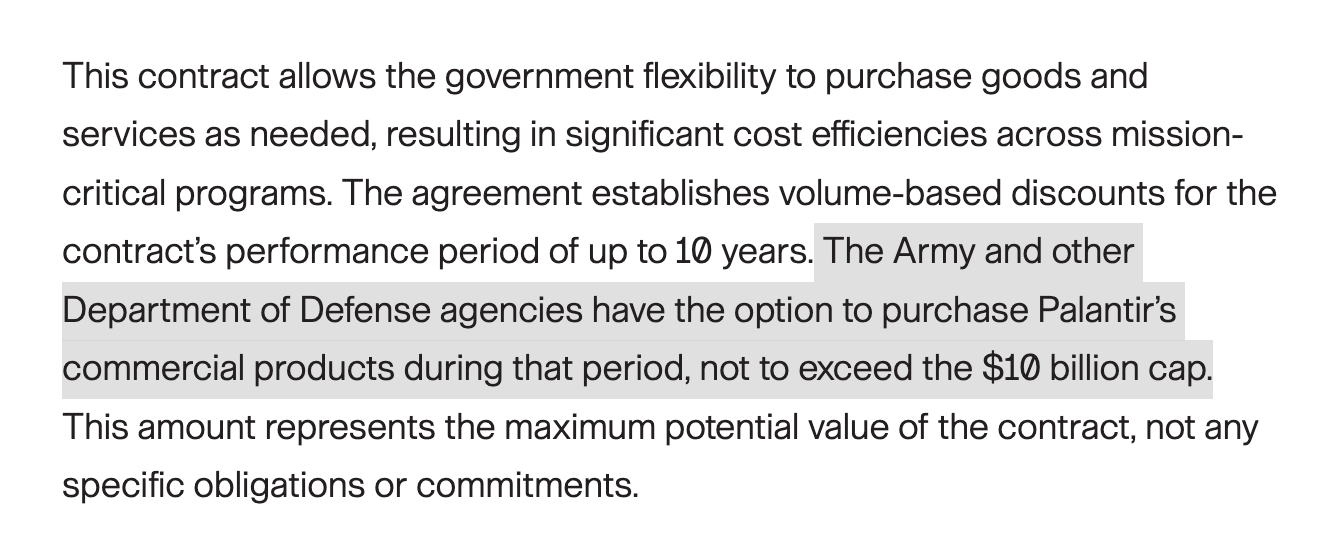
In July 2025, the U.S. Army announced an enterprise service agreement allowing the Army and other DoD agencies to purchase Palantir products over up to ten years, with a spending cap of $10 billion.
A cap isn’t a guarantee, but the form matters. This is the Army treating Palantir less like a vendor and more like enterprise infrastructure you want easy to pull off the shelf.
The Legitimacy Engine
Once you accept all this, Karp’s communication style snaps into focus.
Silicon Valley culture treats likability as a proxy for legitimacy. That works when your market is consumers and your distribution is persuasion. In institutional markets, legitimacy is closer to permission.
Permission means the institution can defend the purchase to oversight committees, auditors, and its own sense of identity. The buyer has to be able to explain itself after it buys you.
Karp’s real job, then, looks less like “run a software company” and more like “run a legitimacy engine that lets a certain class of institutions adopt certain capabilities without losing face.”
That is a very different CEO job than “build an app people love.” It requires different language, different recruiting, different tolerance for controversy, and different time horizons.

The irony: the very traits that make Karp hard to market to mainstream tech culture are the traits that increase trust with institutions.
Institutions are allergic to vibes.
They want continuity and commitment.
Karp’s refusal to sand down his worldview is part of how he sells that commitment.
Why It Works
Rather than just the Palantir story, it’s a template for any company (or their founders) trying to sell capabilities, not conveniences, to institutions.
Consumer-tech founders optimize for broad appeal. Institutional operators optimize for trust among buyers who face real consequences. The playbook is different: commitment signals instead of PR polish, embedded deployment instead of self-serve scale, controversy tolerance instead of universal likability.
The companies that win the next decade in institutional markets may look “wrong” through the consumer-tech lens. Too serious. Too opinionated. Too tied to specific customers. Too willing to alienate broad audiences.
But that is not a bug. That’s the strategy.
Most CEOs are misunderstood because people misjudge their skill or luck.
Karp is misunderstood because people misjudge his market.
When Palantir takes heat for controversial contracts, that doesn’t hurt them with the customers who matter. It helps.
It proves to defense buyers and intelligence agencies that this company won’t buckle under activist pressure. It proves the commitment signal is real.
The controversy, the polarization, the refusal to soften his worldview: these aren’t liabilities in his market.
They’re the product.
The consumer-tech vs institutional-tech distinction is incredibly clarifying. It explains not just Palantir’s strategy, but why so many companies fail when they misread the kind of system they’re actually building. Great piece.