

The 2 Page Document That Cost $2 Billion
How Einstein's words convinced a President to fund the atomic bomb

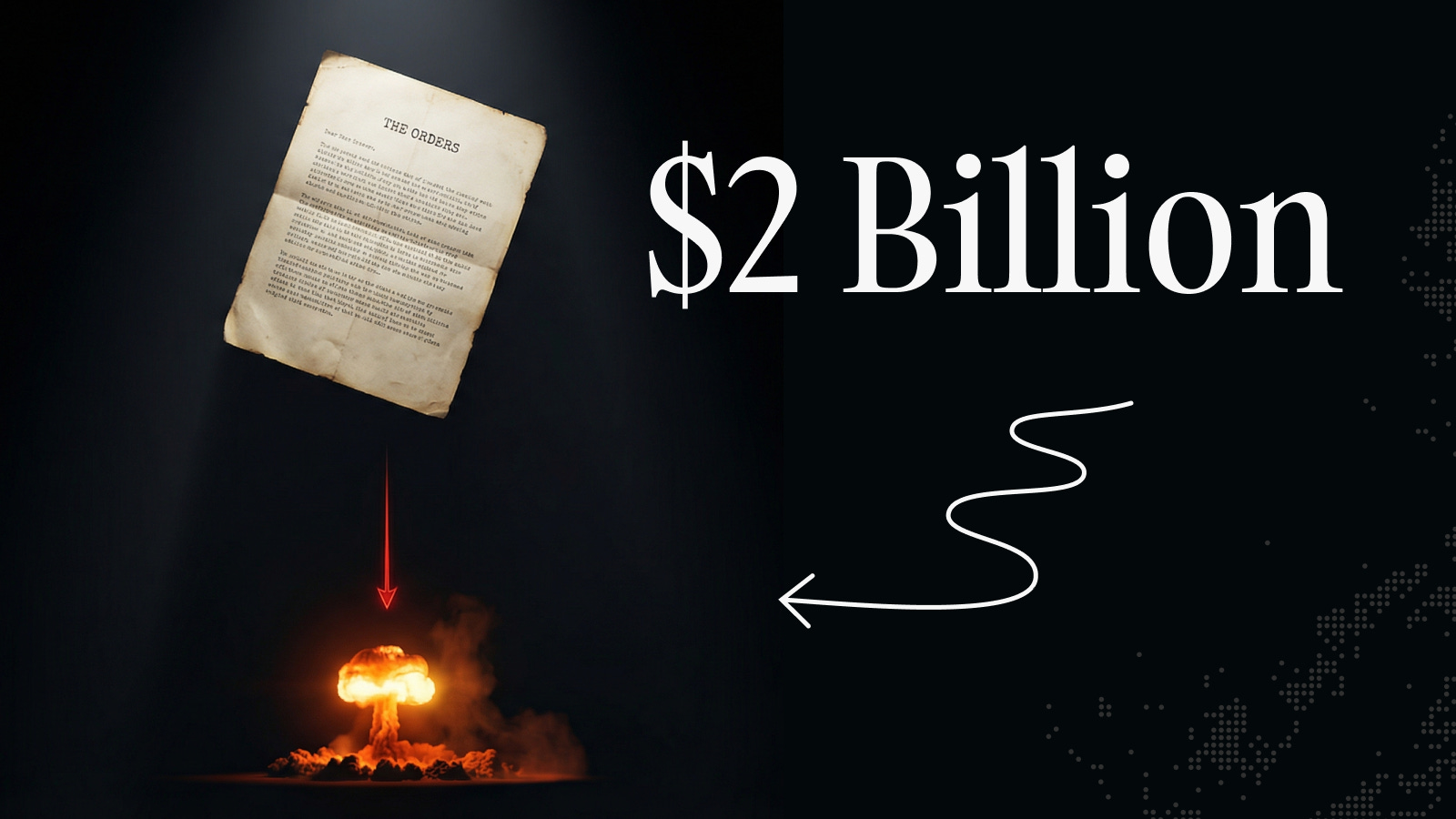
In August 1939, Albert Einstein sat down on Long Island and wrote a two-page letter. By the time its consequences finished unfolding, the United States had spent $2.2 billion (about $46 billion today), employed 130,000 people, and built a weapon that ended one war while starting an entirely new kind of fear.
Two pages. That’s it.
No detailed budget. No technical specifications. No multi-year roadmap. Just a few hundred words that converted a chaotic pile of uncertain physics into something a President could act on without looking reckless.
I used to assume history turned on speeches, on grand moments of oratory. Then you start noticing how often it actually turns on paperwork.
A war starts because of a telegram. A company pivots because of a memo. A scientific field reorganizes itself because of a short preprint. The big machinery only moves after someone produces a small artifact that makes movement permissible.
If you care about how power actually moves in the real world, Einstein’s letter to Roosevelt is the ultimate case study.
The Mechanics of the Letter
I spent a lot of time with this document. The original sits in the FDR Presidential Library archives, dated August 2, 1939, written from Old Grove Road in Peconic on Long Island. You can read every word. And what strikes me isn’t the physics. It’s the structure.
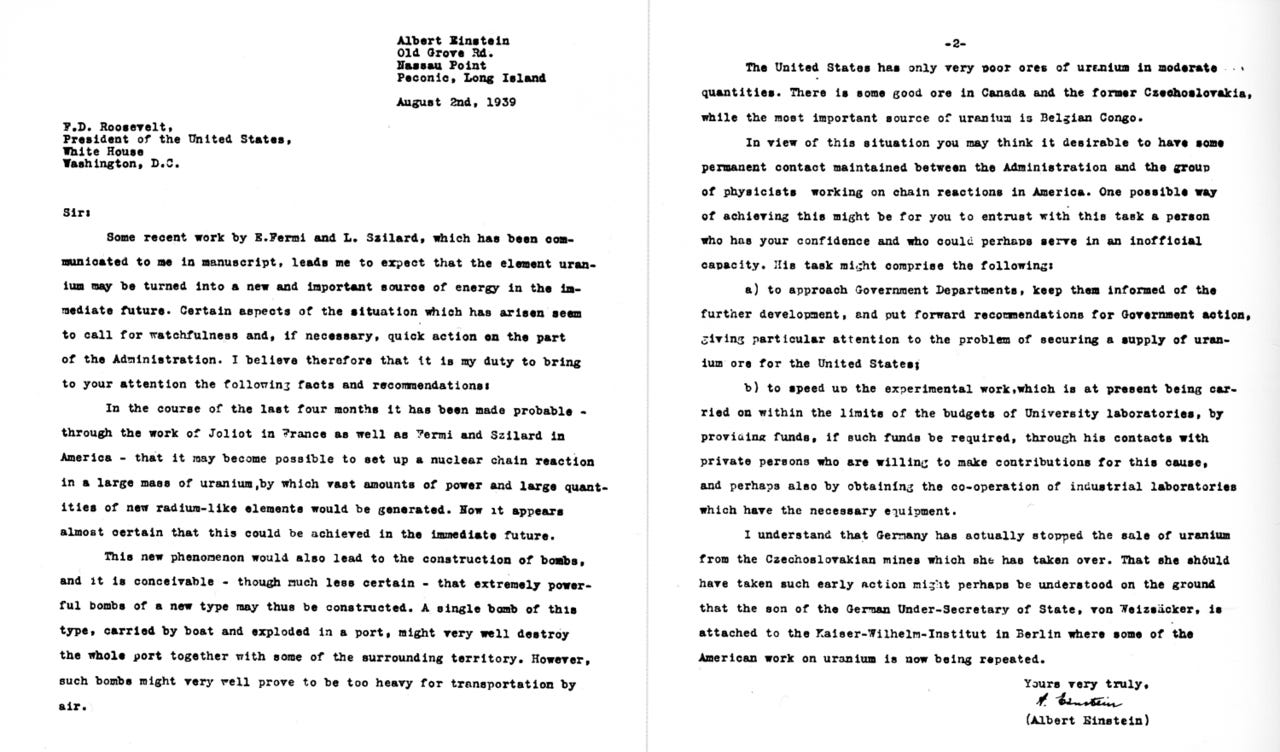
The letter opens with a move that’s easy to miss: Einstein immediately attributes the underlying work to others. “Some recent work by E. Fermi and L. Szilard,” he writes, “leads me to expect…”
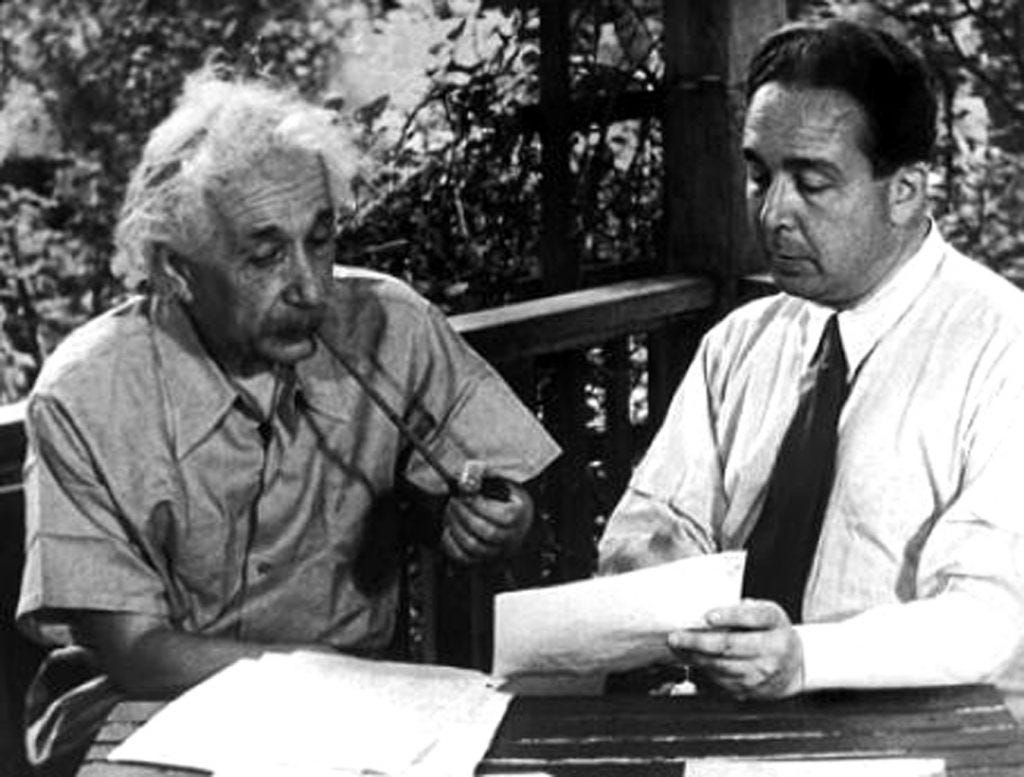
Enrico Fermi was already famous among physicists. Leo Szilard was less famous to the public, but he mattered here more than almost anyone. Szilard was a Hungarian-born physicist who had been thinking about chain reactions for years and who had the political urgency of an immigrant watching Europe (once again) slide into catastrophe.
Einstein was the amplifier. Szilard was the engine.
Then comes something else that’s easy to miss: the letter mixes scientific possibility with operational guidance. Einstein tells Roosevelt that a nuclear chain reaction in uranium may be possible “in the immediate future,” and that this would lead to power and “the construction of bombs.”
He’s careful about uncertainty. He notes that it is “conceivable” that “extremely powerful bombs of a new type” could be built, but also that such bombs might be too heavy for delivery by air.
That last detail is one of my favorites. In the same paragraph where he helps usher in the nuclear age, Einstein still imagines the bomb as something “carried by boat and exploded in a port.” The future arrives wrapped in the constraints of the present.
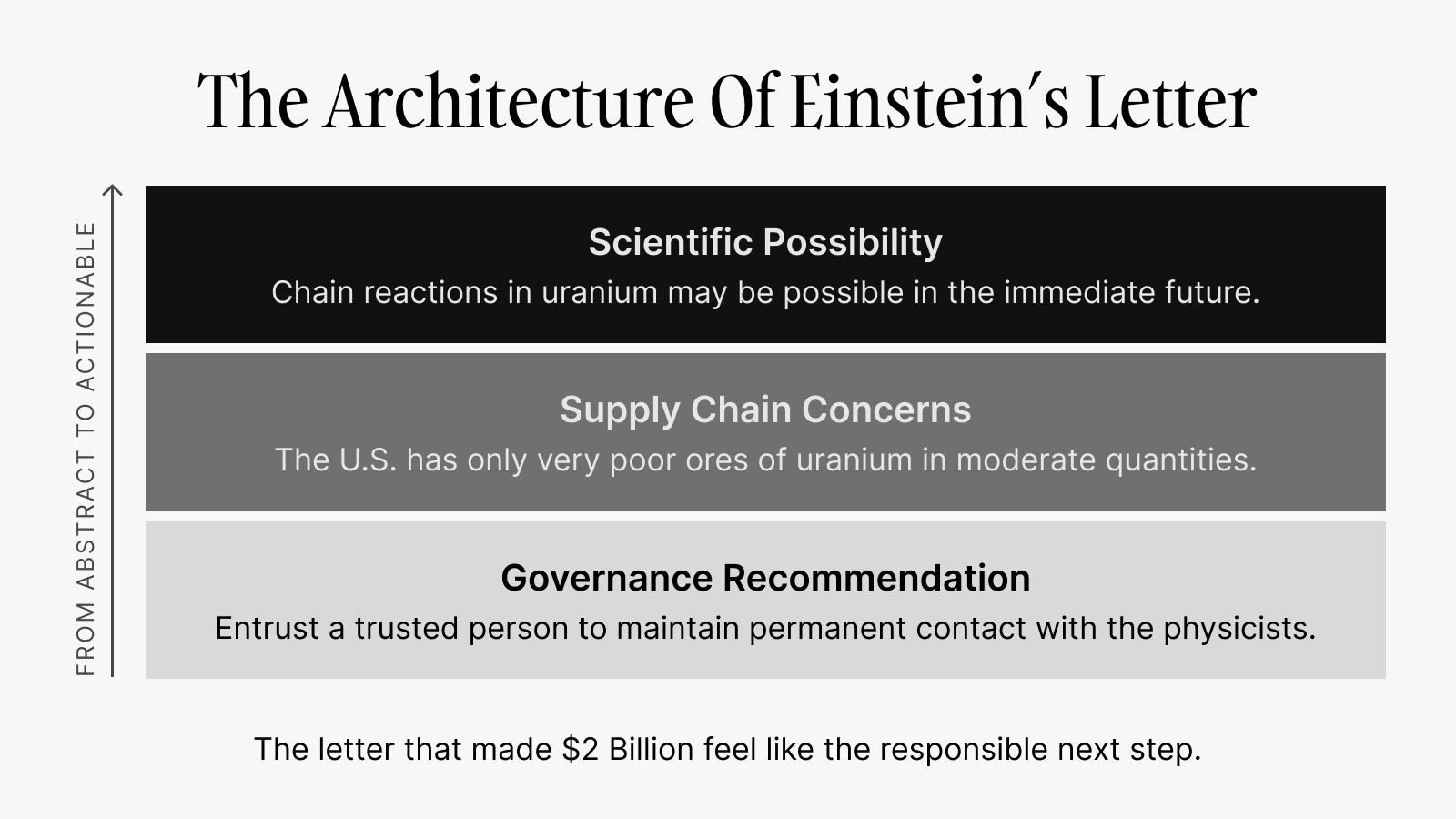
On the second page, the letter pivots into supply chains. The U.S. has “only very poor ores of uranium in moderate quantities,” he says, and points to Canada, Czechoslovakia, and the Belgian Congo as important sources.
This is one of the tells that the letter was written by people who were thinking concretely. The letter goes beyond “science might do X” to specify exactly where the operation would choke if X turned out to be real.
The Routing Problem
If you want to understand the letter’s force, you have to understand that it was not inevitable that Einstein would be the signer.
The Franklin D. Roosevelt Presidential Library has a short post about the letter that includes this sentence: because Einstein had a prior personal relationship with the Roosevelts and was internationally well-known, a letter was drafted for his signature.
That is blunt, almost to the point of being uncomfortable. Einstein would get read. That was the entire calculation.
This is a thing smart technical people learn late: in large systems, the constraint is often not truth. It is routing. You can have the right idea and still fail if you cannot get the idea to the person who can authorize motion, in a form that survives the trip.
I think about Barry Marshall, the Australian doctor who in the 1980s couldn’t convince the medical establishment that ulcers were caused by bacteria rather than stress.
He had the evidence. He published peer-reviewed papers. Nothing moved. The field had seen the data, but ordinary proof simply couldn’t reorganize an economy of attention and belief that had calcified around stress as the cause.
So Marshall drank a suspension of Helicobacter pylori, gave himself gastritis, and cured it with antibiotics. He needed something dramatic enough to force a recategorization.
Einstein’s letter solved a similar problem through different means. His name was a form of preloaded legitimacy, a credibility escrow account. You could spend it to buy attention from the highest level of government.
And there’s another routing detail that gets smoothed over: the letter was not immediately delivered.
The National Archives notes that Alexander Sachs, a Wall Street economist and Roosevelt adviser, personally delivered it on October 11, 1939, after the outbreak of World War II delayed the initial attempt.
Einstein and Szilard didn’t just “write to the White House.” They found a person who could walk it into the room. The DOE’s Manhattan Project history describes Sachs meeting Roosevelt, initially struggling to persuade him, then succeeding at a second meeting over breakfast.
The Roosevelt Library’s post adds the most quoted line: after learning the contents, Roosevelt told his military adviser, General Edwin “Pa” Watson, “This requires action.”
That phrase is the hinge. The moment a possibility becomes an administrative obligation.
Category Creation
Why did those three words matter so much? Because until Roosevelt said them, the atomic bomb didn’t exist as a category of legitimate government concern.
This is the part that took me the longest to understand. The “problem” with nuclear weapons in 1939 wasn’t that nobody understood fission. Physicists had been publishing about chain reactions. The problem was that no government had installed “atomic bomb” as a real category of risk yet.
Before the category exists, action looks paranoid. After the category exists, action looks responsible.
Einstein’s letter created the category.
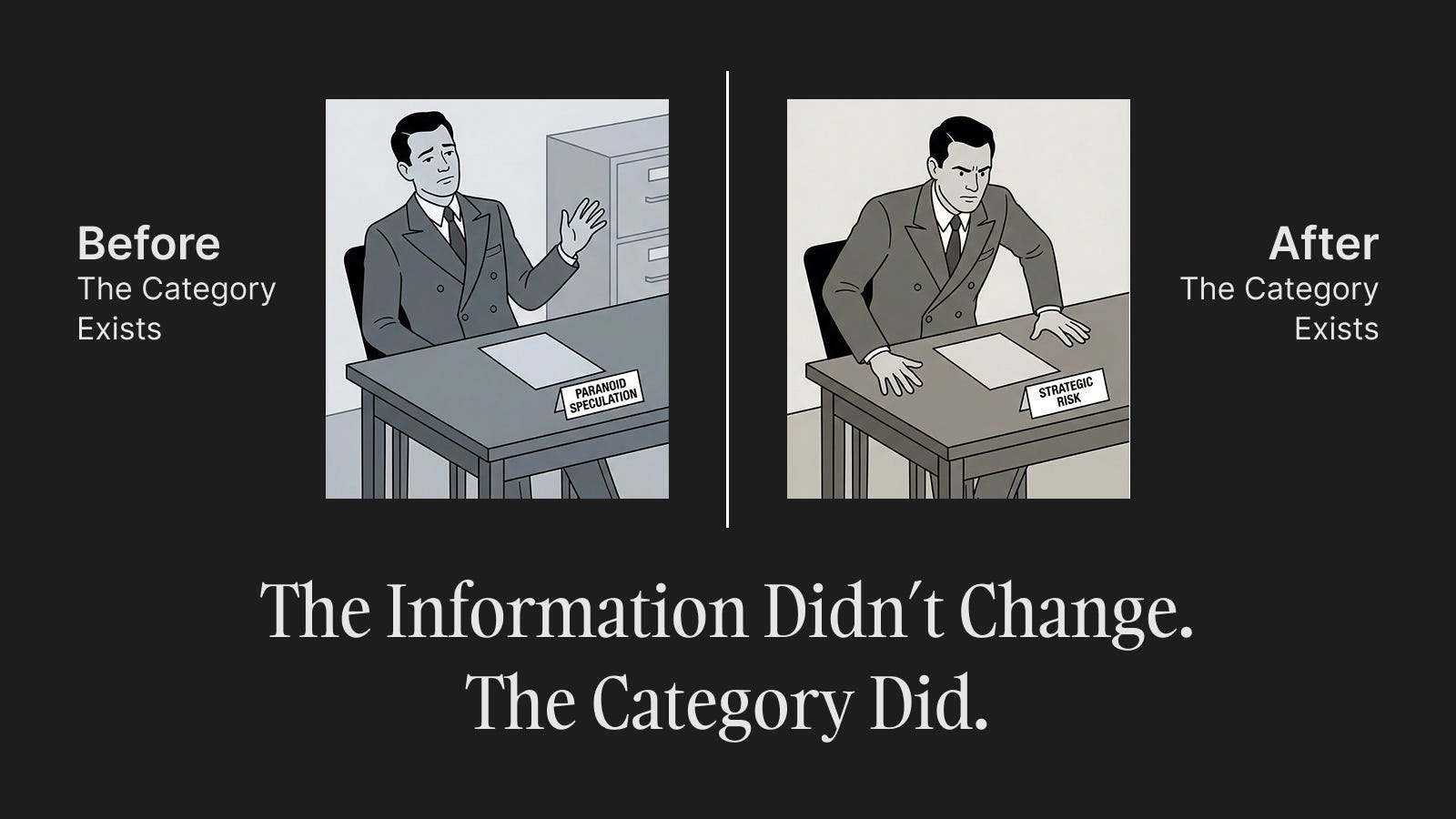
Once “atomic bomb” existed as a legitimate object inside the administrative imagination of the U.S. government, it could be staffed, funded, argued about, and escalated.
The letter didn’t contain the Manhattan Project. It contained the seed of a decision tree. It created an official pathway for nuclear work, which then intersected with other inputs (British conclusions, wartime pressures, organizational restructuring) that changed the slope.
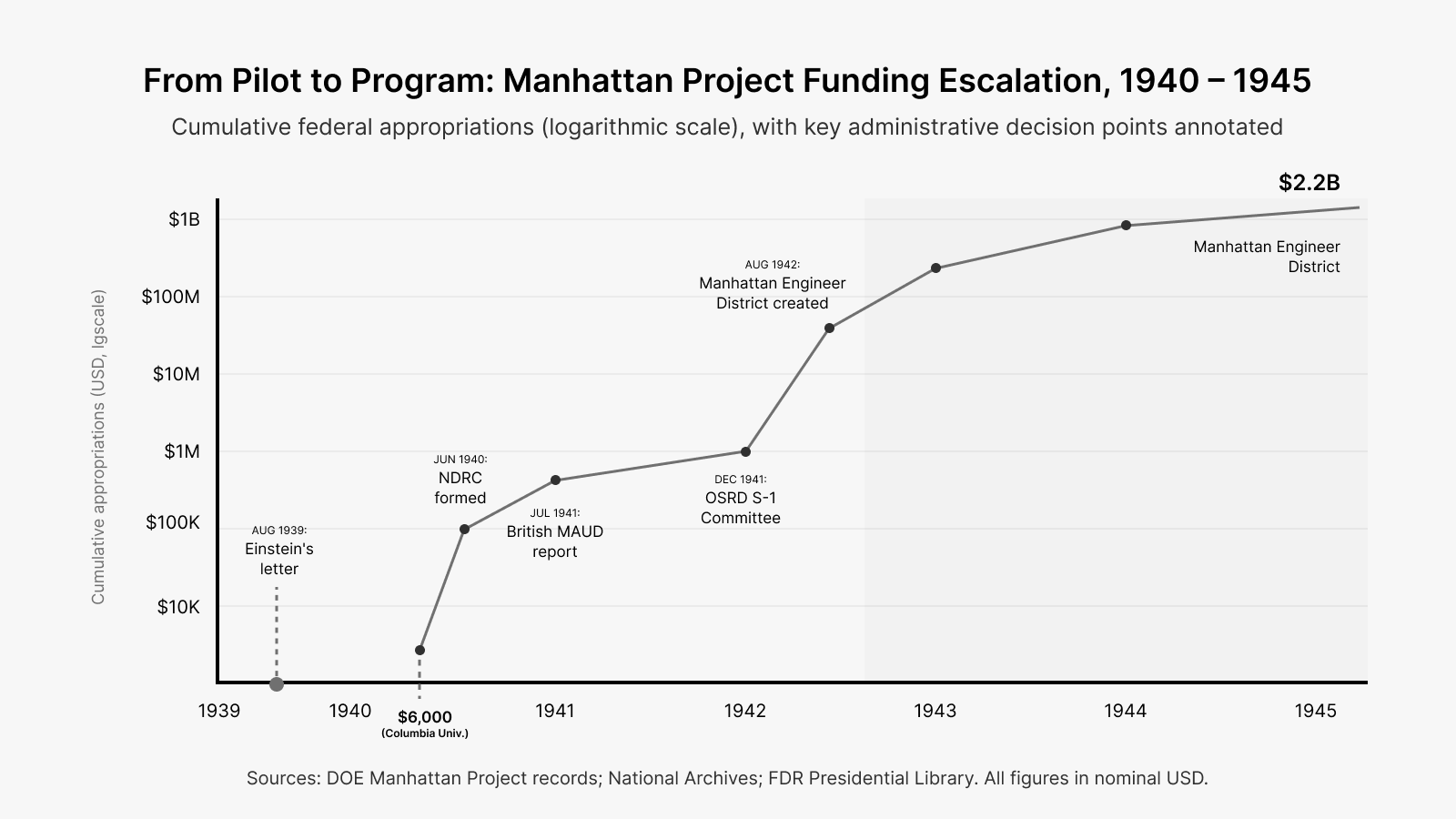
The first action was almost comically modest. The uranium committee met on October 21, 1939, recommended acquiring graphite and uranium oxide, and in February 1940 allocated $6,000 to support chain reaction research at Columbia University.
Six thousand dollars is a rounding error in federal budgets, even back then. It is also exactly what early-stage commitment looks like when a system is still deciding whether a new reality is real. You don’t get the blank check. You get the pilot.
But that pilot existed because the category existed. And categories compound.
In June 1940, the uranium committee was subsumed under the National Defense Research Committee, created at the urging of Vannevar Bush. In July 1941, Bush received the British MAUD Committee report estimating a critical mass of uranium-235 around ten kilograms, enough for an enormous explosion, buildable in approximately two years.
By August 1942, the Manhattan Engineer District was officially created. At its peak: 130,000 workers, $2.2 billion spent, over $30 billion in 2023 dollars.
The letter didn’t cause all of that directly. But it made all of that administratively possible.
Writing as a Control Surface
So what was the letter, functionally?
The more I sit with it, the more I think the answer is: a control surface. Writing, in environments where resources are concentrated, reaches into the future and rearranges what becomes possible.
Einstein asks Roosevelt for one thing: a channel. Someone Roosevelt trusts to coordinate across departments, secure uranium ore supply, and speed experimental work. Big projects rarely start with fully funded programs. They start with a person who can carry the problem across the internal borders of a large system.
Einstein also includes a specific claim meant to make the risk feel immediate: Germany has stopped the sale of uranium from mines in Czechoslovakia that it has taken over. He adds a detail about the Kaiser Wilhelm Institute in Berlin and the son of German Under-Secretary of State von Weizsäcker being attached there.
Even if you don’t know how accurate each micro-claim was at the time, you can see what it’s doing structurally. It turns “Germany might” into “Germany is already acting.” A warning becomes a race.
The letter offered Roosevelt a frame where action was prudence and inaction was the real risk. The memos that move resources are rarely the memos that ask for everything. They’re the memos that make the first step unavoidable, and trust that the rest will compound.
When people ask what “narrative power” means, they often expect messaging tricks, clever framing, and persuasion tactics.
Narrative power operates at a deeper level. It is the ability to make a certain course of action feel inevitable, or at least defensible, under uncertainty. It is the ability to install categories that redirect budgets, careers, and national priorities. It operates through small artifacts that cross institutional borders and make movement permissible.
Einstein’s two-page letter is one of the cleanest examples in modern history.
It is short. It is concrete. It is written in the receiver’s language. It comes with preloaded legitimacy. It asks for one thing: a channel. It grounds the physics in supply chains and bottlenecks. And it creates a category where none existed before.
That combination is rare. When it happens, two pages can make $2 billion feel like the responsible next step.
There’s one more detail worth holding. Einstein became a U.S. citizen in 1940, but the Army denied him a security clearance. He was never part of the Manhattan Project, never set foot in Los Alamos.
The system used his legitimacy to justify action while keeping him far from the execution. Once you set a system in motion, the system becomes its own actor. You can start the chain. You cannot steer every link.
I keep asking myself which decisions are sitting in the “looks paranoid” bucket right now that will, five years from now, sit in the “obviously necessary” bucket.
Somewhere, someone is writing the two-page document that will make the difference.
If you’re working on something that needs to cross an institutional border, I’d genuinely like to hear about it. Hit reply.