

How a Dinosaur Movie Created K-Pop
One government memo about Jurassic Park's box office rewired an entire country's economy - and the global music industry.

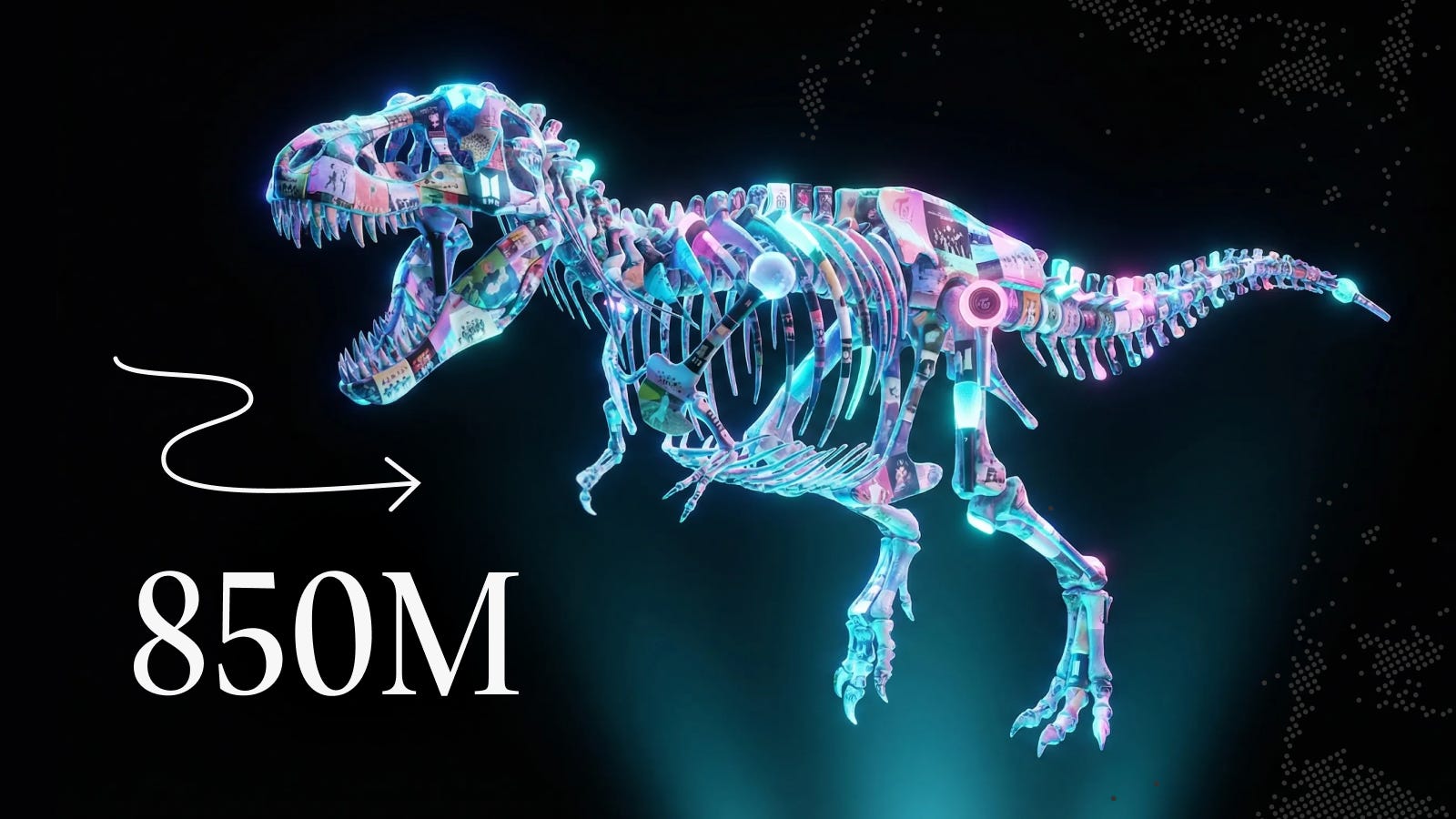
On May 17, 1994, a group of South Korean government scientists walked into the president’s office and presented a memo about dinosaurs. Not real ones. Steven Spielberg’s dinosaurs.
Their argument was simple: Jurassic Park had grossed $850 million worldwide, which was equivalent to the foreign sales of 1.5 million Hyundai automobiles. Korea, at the time, exported barely 700,000 vehicles per year.
A single Hollywood film was worth more than twice the country’s entire annual car export volume.
The president read the memo. The government created a Cultural Industry Bureau.
Four years later, in the middle of the worst financial crisis in the country’s history, South Korea’s new president made a bet that most economists thought was insane: he would spend his way out of the crisis by manufacturing pop culture.
Thirty years later, 9 of the 10 best-selling albums on the planet are Korean.
This is the story of how that happened.
The Memo That Rewired a Country
The memo wasn’t vague. It wasn’t a soft plea about “investing in the arts.” South Korea’s Presidential Advisory Council for Science and Technology titled it “Strategic Plan for the Growth of High-Tech Visual Arts,” and the arithmetic was blunt: Jurassic Park grossed $850 million on a $63 million budget.
That revenue equaled the foreign sales profit of 1.5 million Hyundai cars. Korea exported barely 700,000 vehicles that year.
A dinosaur movie, made in eighteen months, out-earned the entire country’s annual car export volume by more than two to one.
Scholars Vincenzo Cichelli and Sylvie Octobre later named this “the Jurassic Park syndrome”: the moment popular culture became viewed as a commodity with exchange value exceeding industrial goods.
The government created a Cultural Industry Bureau with an initial budget of 5.4 billion won ($4.1 million). Modest. Almost symbolic.
Then the 1997 Asian financial crisis hit.
South Korea took a $58 billion IMF bailout, the largest at the time. The economy cratered.
And incoming President Kim Dae-jung, inaugurated in 1998, made what looked to most economists like a reckless bet: spend your way out of a financial crisis by manufacturing pop culture.
The policy mechanics were aggressive, to say the least.
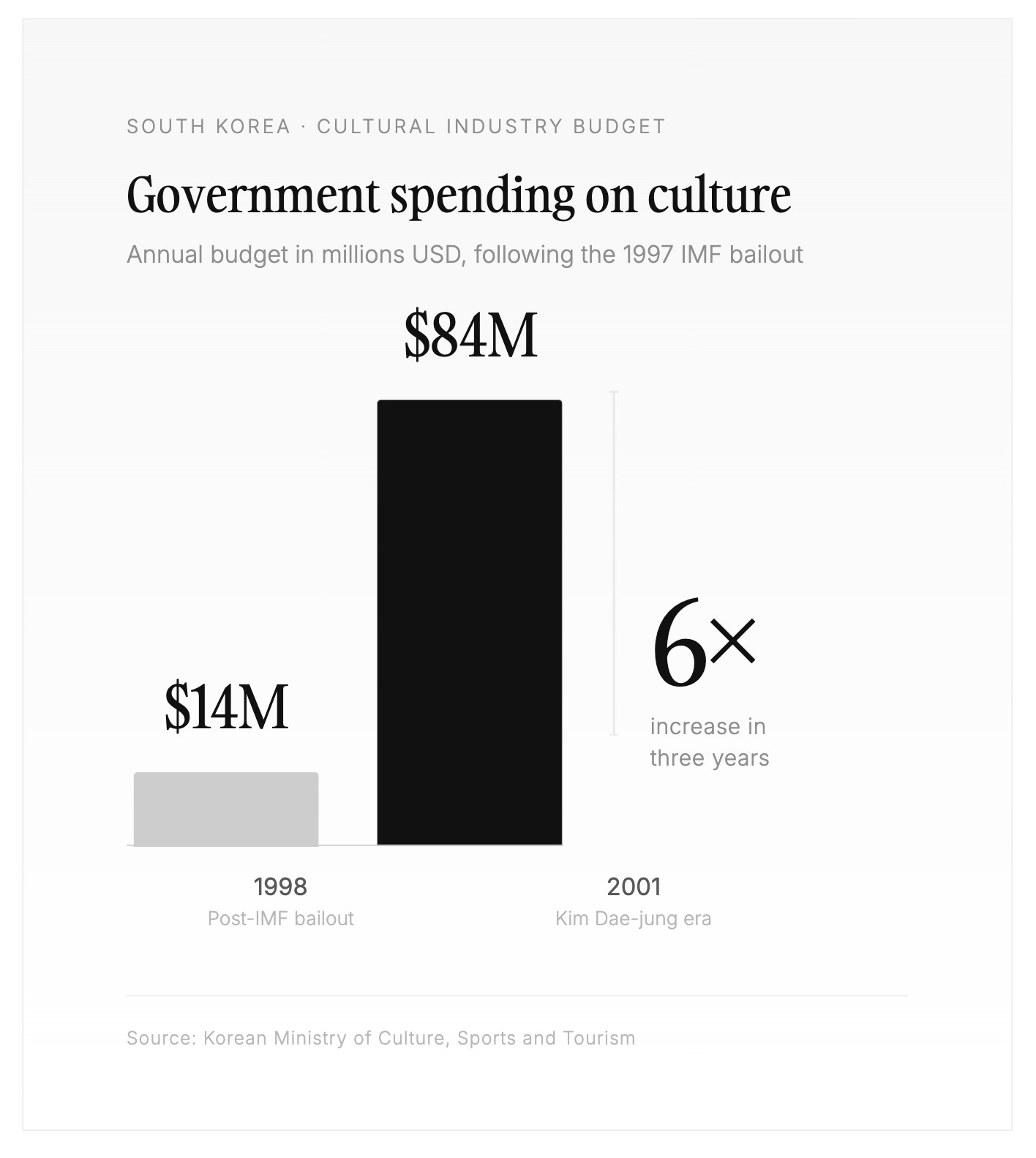
Government spending on culture jumped from $14 million in 1998 to $84 million by 2001. The music industry budget alone surged from 940 million won in 1997 to 14.5 billion won in 2000, a fifteen-fold increase in three years.
The 1999 Framework Act for the Promotion of Cultural Industries established the first comprehensive legal definition of cultural products and mandated tax incentives and export subsidies.
The Korea Creative Content Agency (KOCCA) received a mandate to subsidize record companies, fund overseas tours, and staff international music expos, eventually opening offices in the US, France, China, Japan, India, Indonesia, and Vietnam.
Government officials arranged ad sales for Asian TV stations so those stations would accept ready-to-play packages of Korean soap operas, already translated and subtitled, at no cost.
As journalist Euny Hong put it: “There was zero market for Korean popular culture. It had to be force-fed into foreign markets.”
The term “Korean Wave” (Hallyu) was coined by Chinese journalists in a 1999 Beijing Youth Daily article. They expected it to be a fad.
A country in the middle of the worst financial crisis in its history had looked at its balance sheet and decided the answer was boy bands and soap operas.
The Trust Layer
Why would anyone outside Korea care about Korean pop culture in the first place? The sequencing tells you everything. Korean industrial products established global credibility first. Cultural exports rode on that trust.
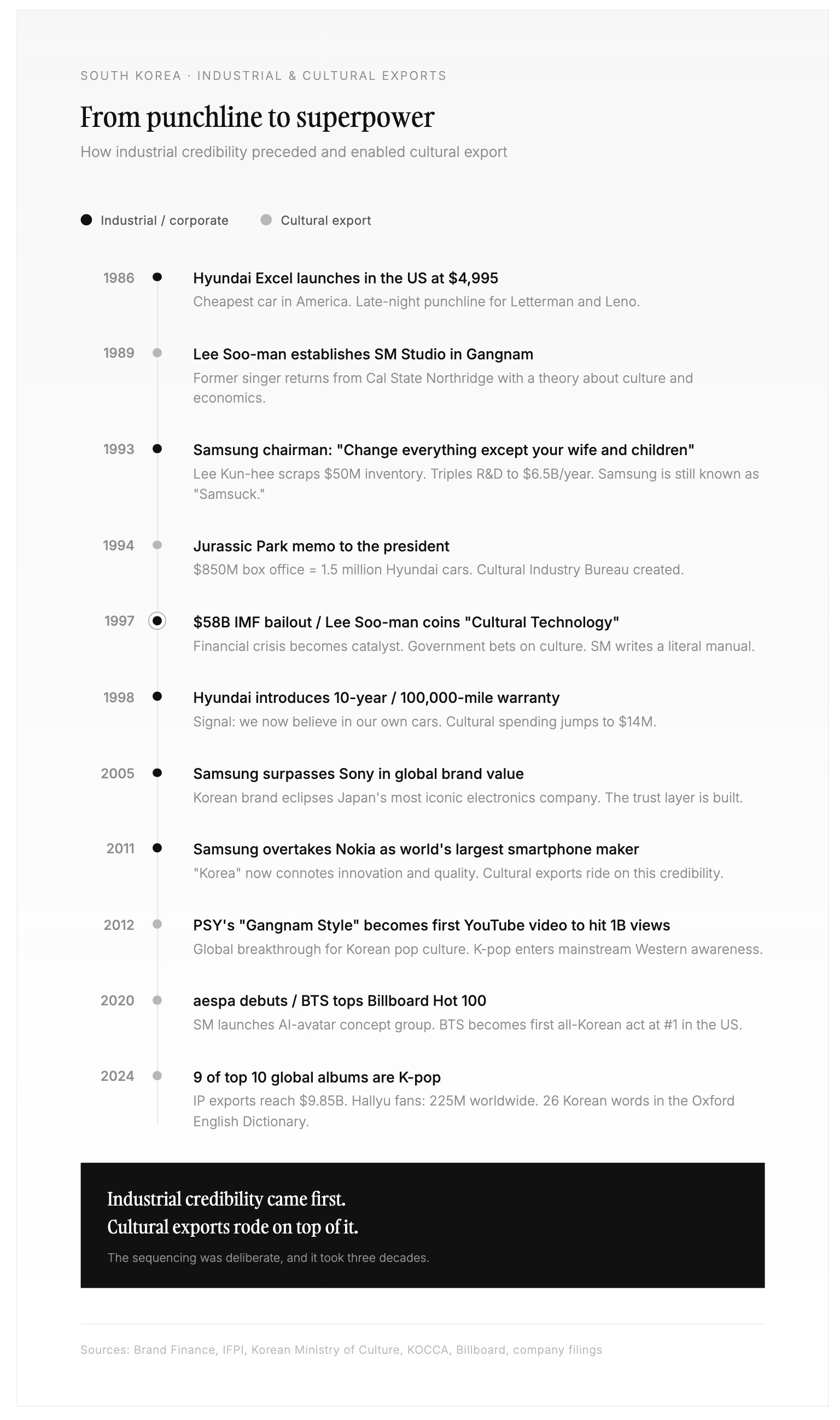
In the early 1990s, Samsung was known among expats as “Samsuck.” Hyundai’s Excel, launched in 1986 at $4,995 (the cheapest car available in America), was a recurring late-night punchline. Jay Leno made it a regular target. Consumer Reports relentlessly attacked its reliability.
Korea, in the Western imagination, meant cheap goods.
The transformation was very deliberate.
In 1993, Samsung’s chairman Lee Kun-hee gathered 200 executives in Frankfurt and told them to “change everything except your wife and children.”
The company scrapped $50 million in inventory, tripled R&D to $6.5 billion annually, and shifted from lifetime employment to merit-based promotions.
By 2005, Samsung surpassed Sony in global brand value. A Korean brand eclipsing Japan’s most iconic electronics company. By 2011, it overtook Nokia as the world’s largest smartphone maker, a position it held for 14 consecutive years.
In 1998, Hyundai introduced a 10-year, 100,000-mile powertrain warranty. The message: we now believe in our own cars. The brand went from punchline to J.D. Power’s Highest in Initial Quality award by 2019.
By the time Korean pop culture arrived in Western markets in the 2010s, “Korea” no longer connoted cheap goods. It connoted Samsung phones, Hyundai reliability, and LG appliances.
The top 10 Korean conglomerates account for roughly 60% of the country’s GDP.
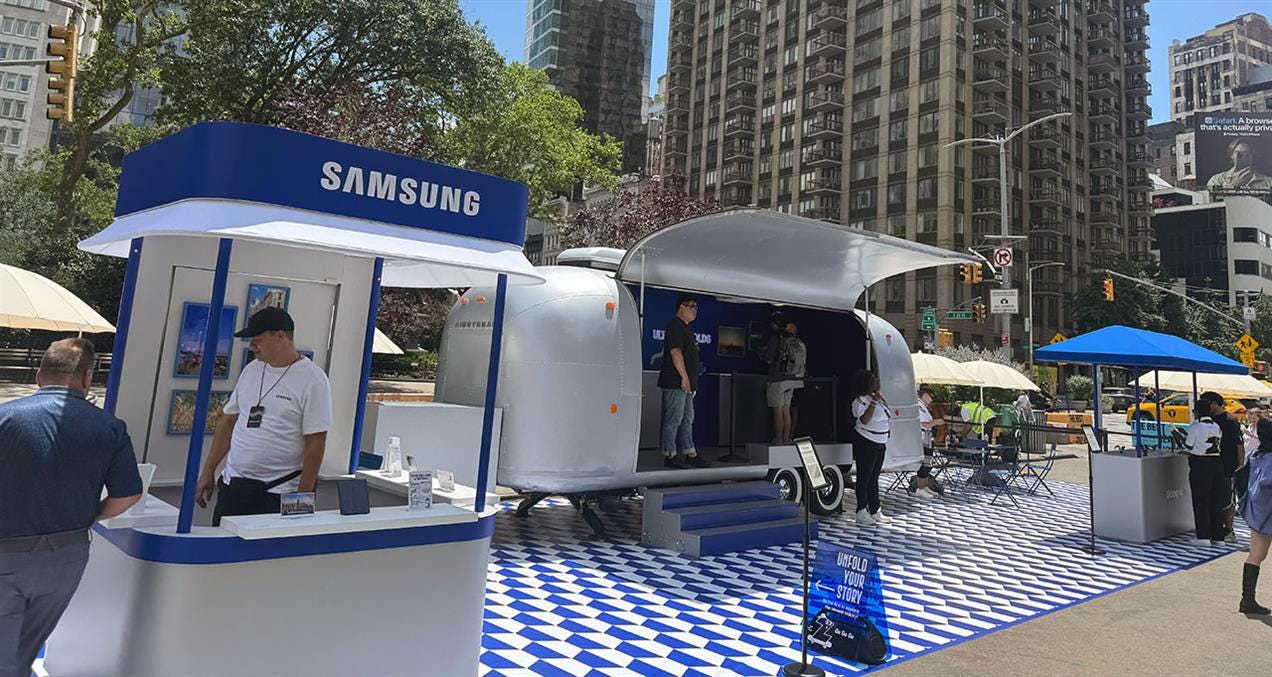
I visited Seoul in 2024, and what struck me first was the grooming. Everyone was immaculately polished, in a way that went beyond fashion and into something closer to national discipline. I found myself dressing more carefully just to avoid feeling conspicuous.
That sensibility comes from the same coordination culture that turned Samsung from a punchline into the world’s largest smartphone maker: the instinct to engineer quality into every visible surface.
The pop music system just happens to be where that instinct became most legible to the outside world, second only to the dramas.
The Engineer Who Wrote a Manual for Making Pop Stars
The government built the policy infrastructure: subsidies, legal frameworks, export support, and overseas offices.
But policy alone does not produce pop stars. Someone had to build the production system that could absorb those resources and convert them into exportable culture at scale.
That person was Lee Soo-man.
Lee was a modestly successful singer and TV emcee in 1970s Korea before leaving for California to study computer engineering at Cal State Northridge. While there, he witnessed Michael Jackson’s rise and the MTV revolution.
He came back with an inversion that reshaped an entire industry:
“Up until that time, the majority of people thought that it is only when you become a big and wealthy country that your culture gets to shine globally. Economy comes first and then culture will follow. But I started thinking in the opposite way, that culture should be first and then economy next.”
He established SM Studio in 1989 in the Apgujeong neighborhood of Gangnam, Seoul. His first signed artist, hip-hop singer Hyun Jin-young, was arrested for drug use, destroying the investment.
That failure was absolutely pivotal. Lee decided to build a system that ensured nothing was left to chance. The scandal inoculated SM against ever trusting talent development to organic processes again.
Modern K-pop, in its entirety, exists downstream of this moment. If you are a fan of BTS, aespa, or Blackpink, you have Mr. Jin-young’s behavior to thank for it.
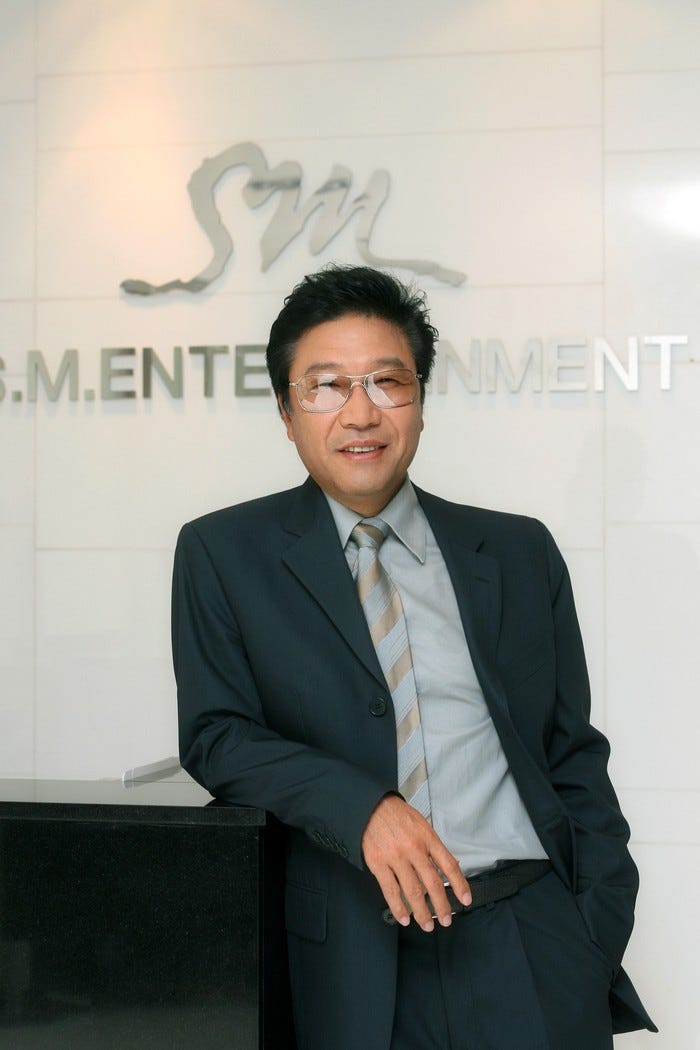
Around 1997, he coined the term “Cultural Technology” (문화기술) and wrote a literal physical manual that SM employees were required to study.
His head of A&R, Chris Lee, explained to Billboard:
“Mr. Soo-man Lee has this mindset that when it comes down to technology or computer science, there’s always a manual. So he wanted to make sure that we have those manuals, specific manuals to follow to aim for perfection when creating creative content.”
His training as an engineer produced an entertainment system with the rigor of an engineering specification. SM receives approximately 300,000 applicants across nine countries every year. Roughly 100 receive training.
Of all trainees who enter the system, about 1% ever debut. The cost of developing a single idol was estimated at $3 million per member. Debuting an entire group costs $7.5 million or more.
Each group was designed for a specific strategic purpose.
H.O.T. (1996) was formed by polling high school students to determine what teenagers wanted.
BoA (2000) was deployed to conquer the Japanese market at age 13.
Later groups pushed the logic further: sub-units singing identical songs in Korean and Mandarin, city-based franchises designed with unlimited members.
This is what it looks like when government cultural investment meets an engineer’s instinct for systematization: not one artist hoping for a breakthrough, but a production system calibrated to generate them in sequence.
What happens inside that system has a texture that’s difficult to convey without gruesome specifics.
Former SM trainee “Euodias” described it in a 2020 BBC feature: each trainee was assigned a number, and instructors called them only by their numbers, read from stickers on their shirts.
“It felt weird, a bit like we were in some sort of science experiment.”
Trainees were divided into Team A and Team B, “largely based on visual potential and body weight, not skill.”
Weight surveillance is institutionalized. Companies weigh trainees publicly, announcing numbers out loud. Public shaming being insufficient, those over the company’s target are placed on water diets or denied food outright.
Companies cover all training costs as an advance loan; trainees who leave without debuting face penalties ranging from $86,200 to $129,000.
The system reformed somewhat after the TVXQ lawsuit of 2009, when three members of SM’s biggest boy group sued over their 13-year contract, claiming they worked with only four hours of sleep and received almost none of the profits.
The court ruled in their favor, and the Fair Trade Commission limited entertainment contracts to seven years.
The system reformed enough to survive. It didn’t soften.
What the System Produces
The girl group aespa, debuted in 2020, makes a useful case study because the group makes all of this infrastructure visible rather than hiding it.
One member, NingNing, moved from Harbin, China, to South Korea alone at age 14 and trained for five years. She was the only member of her trainee cohort to survive to debut. Every other trainee from her class was cut. Another member, Giselle, trained for approximately eleven months.
Same group. Same debut day.
Their concept pushes the engineering into the aesthetic itself. Each member has a digital AI avatar counterpart existing in a virtual dimension called KWANGYA. Even the members struggled with the lore. But member Karina captured the concept’s tension perfectly:
“æ-Karina doesn’t make mistakes. But I can make mistakes.”
By 2023-2024, SM quietly began retreating from the heavy KWANGYA narrative, shifting toward simpler aesthetics. Even the engineers recognized the concept had outrun its usefulness. But the instinct it expressed, making the construction visible rather than hiding it, remains the group’s defining characteristic.
The Unpaid Operations Department
The government built the policy infrastructure. Lee Soo-man built the production infrastructure. Neither fully explains how Korean music achieved the chart dominance it has today.
That required a third layer: the fans.
K-pop fandoms operate through what Korean fans call chonggong (총공, “collective attack”): coordinated mass action to break digital metrics. This is a decentralized operation performing the work traditionally done by marketing departments, except no one draws a salary.
The sophistication is operational, not just emotional. Streaming guides specify platform rules: on Spotify, play each song for 30+ seconds, switch between 3-4 playlists, include non-K-pop songs to avoid bot detection, pause every 20-30 minutes, mute the device rather than the app.
Fans in Indonesia and India wire money to US-based fans for bulk digital purchases to count toward Billboard charts. BTS ARMY achieved 101.1 million YouTube views in 24 hours for “Dynamite” through organized global shifts.
The Hyundai Research Institute estimated BTS’s annual economic contribution at $4.65 billion, equivalent to the output of nearly 500,000 average Korean workers, or roughly 0.3% of South Korea’s entire GDP.
The scale of fandom coordination has pushed beyond music entirely. BTS ARMY’s #MatchAMillion campaign raised $1,026,531 from 35,609 donors in roughly 24 hours. A single free BTS concert in Busan generated an estimated $500 million in economic value.
And then there’s the chart dominance, and the contradiction at its center.
On the 2024 IFPI Global Album Sales Chart, 9 of the top 10 and 19 of the top 20 best-selling albums worldwide were by K-pop artists. This dominance is partly driven by the fansign lottery system: fans purchase dozens to hundreds of copies of the same album for a chance to meet an idol in person, extract the collectible photocards, and discard the album shells.
Documented photos show boxes of hundreds of K-pop albums dumped on Seoul streets.
Nine of the ten best-selling albums in the world, and piles of them in the gutter.
The Frame That Doesn’t Translate
A system like that (numbered trainees, public weigh-ins, six-figure exit penalties) carries a predictable reputation in Western music criticism.
The framing is always the same: manufactured, artificial, factory-made.
But that reaction papers over a philosophical gap worth examining, because it explains why Western critics have such a hard time taking the music seriously, even as it dominates their charts.
Western pop is also extensively engineered. Swedish producer Max Martin has written or co-written over 25 Billboard #1 hits, surpassing the Beatles’ record of 20.
Berry Gordy Jr. explicitly modeled Motown Records on Ford’s assembly line:
“I worked in the Ford factory before the record business and I thought, why can’t we do that for the creative process.”
The machine exists. The cultural convention, inherited from Romanticism’s insistence that real art flows from individual genius, is to obscure it.
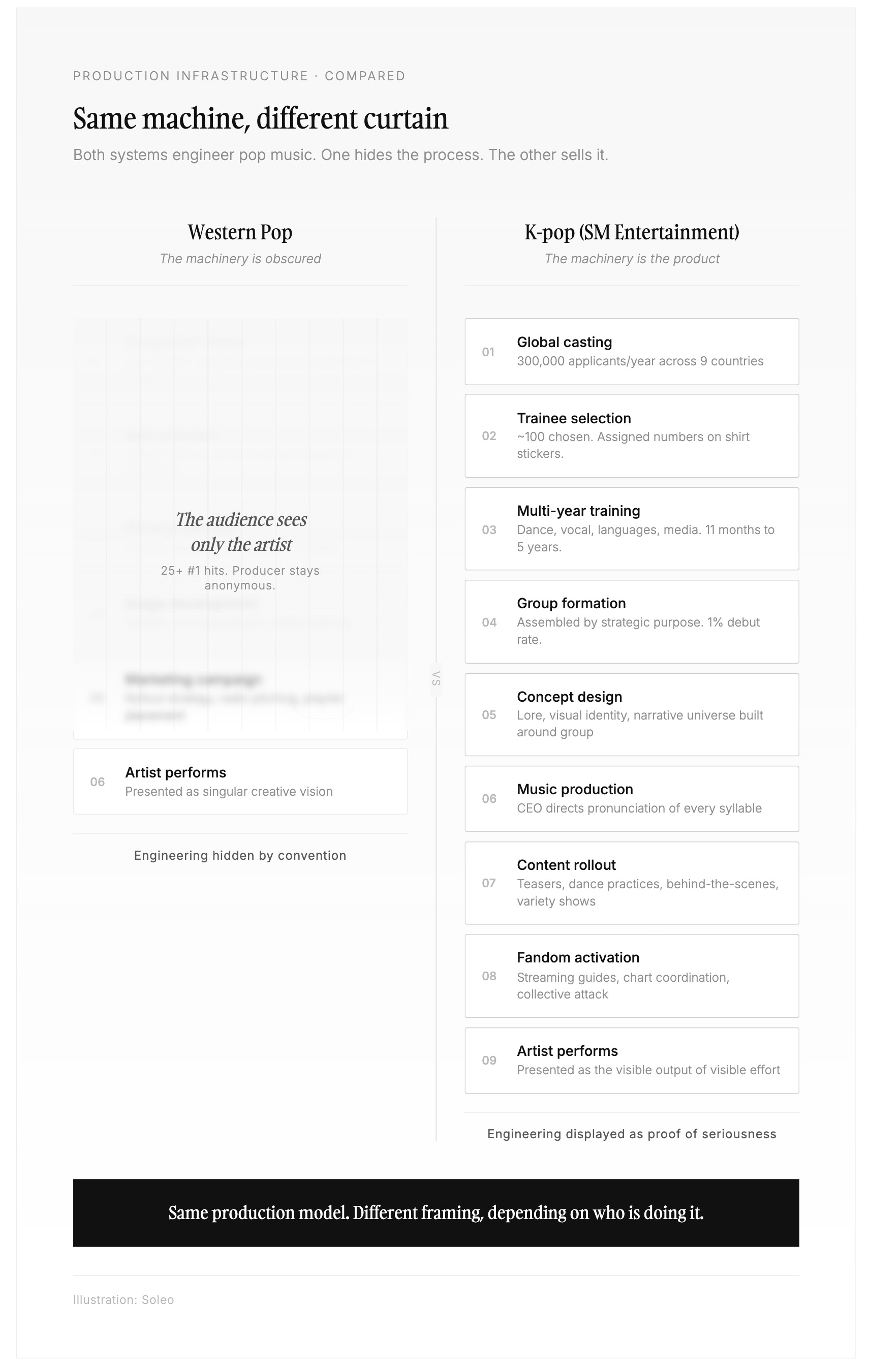
A Seoulbeats analysis identified a particularly telling example: New Yorker writer John Seabrook, in 2012, defended the Norwegian production duo Stargate’s role in creating Rihanna’s hits (”She embodies a song in the way an actor inhabits a role, and no one expects the actor to write the script”), then in the same year framed K-pop’s equivalent process as manufacturing in a chapter titled “Factory Girls.”
Same production model. Different framing, depending on who is doing it.
K-pop doesn’t hide its engineering. Instead, it treats visible effort as a selling point.
A 2025 academic paper in The Journal of Creative Behavior drew parallels between K-pop training and the Pansori concept of Gongryeok (功力): accumulated mastery through dedicated practice rooted in Confucian values.
In one framework, engineering is a mark against authenticity. In the other, it’s proof of seriousness.
What makes this tension productive (rather than merely academic) is how different Korean acts have navigated it.
BTS became the biggest act in the world partly by conforming to the Western authenticity frame: all seven members have had songwriting credits since debut, and RM told interviewers,
“We don’t want to change our identity or our genuineness to get the number one.”
They earned credibility within Western criticism by demonstrating personal authorship.
aespa did something closer to the opposite. The AI avatars, the metaverse, and the lore universe are all transparently constructed and even allude to the real-life SM Entertainment within the story.
The group made no bid for the Romantic ideal. They leaned into the engineering and made the engineering itself an artistic statement.
BTS proved Korean artists could meet the Western standard. aespa asked why they should have to.
What It Looks Like When a Country Treats Culture as Infrastructure
South Korea’s intellectual property exports (music, film, gaming) reached $9.85 billion in 2024, tripling from roughly $3 billion a decade earlier.
Of that total, gaming accounts for 73%; the music and television industries drive disproportionate attention and soft power relative to their direct revenue share.
Global Hallyu fans numbered 225 million in 2023, up from 46 million in 2012. South Korea climbed from 28th to 9th in the Brand Finance Global Soft Power Index for Culture and Heritage between 2020 and 2025, and ranked 1st globally for influential media.
The feedback loop between cultural and industrial exports is now self-reinforcing. K-pop drives interest in Korean cosmetics, fashion, food, tourism, and language study. Cultural exports are building a brand architecture on which everything else appreciates.
Thirty years ago, a government memo compared a Spielberg film to Hyundai sales to argue that culture could be as valuable as industry.
Today, a 14-year-old girl from Harbin moves to Seoul alone, trains for five years, survives a system that cuts everyone around her, and debuts as one quarter of a group whose AI counterparts live in a corporate metaverse at an address that matches the company’s actual building.
The memo’s math has inverted:
Korea no longer measures culture against car exports.
The culture is what makes the world want the cars.